Thaisan Tonthat | Writing
Lenses // Seeing Clearly: On Beliefs, Biases, and Borrowed Ideas

Throw on a pair of sunglasses and suddenly the world feels different — moody, sharper, maybe even a little cinematic. Prescription lenses bring a blur into crisp focus, while tinted ones can turn harsh light into something soft and golden. The world hasn't changed, but your lens has, and that changes everything. Our minds do the same trick. We move through life wearing invisible glasses made of experiences, beliefs, and borrowed ideas. This essay is about recognizing those mental lenses: where they come from, how they influence us, and what happens when we learn to take them off, swap them out, or try on someone else's.
The idea of a lens is somewhere between what Charlie Munger calls a "mental model" and the larger idea of a person's identity shaping the way they experience the world (Paul Graham's essay, "Keep your identity small" is a favorite of mine).
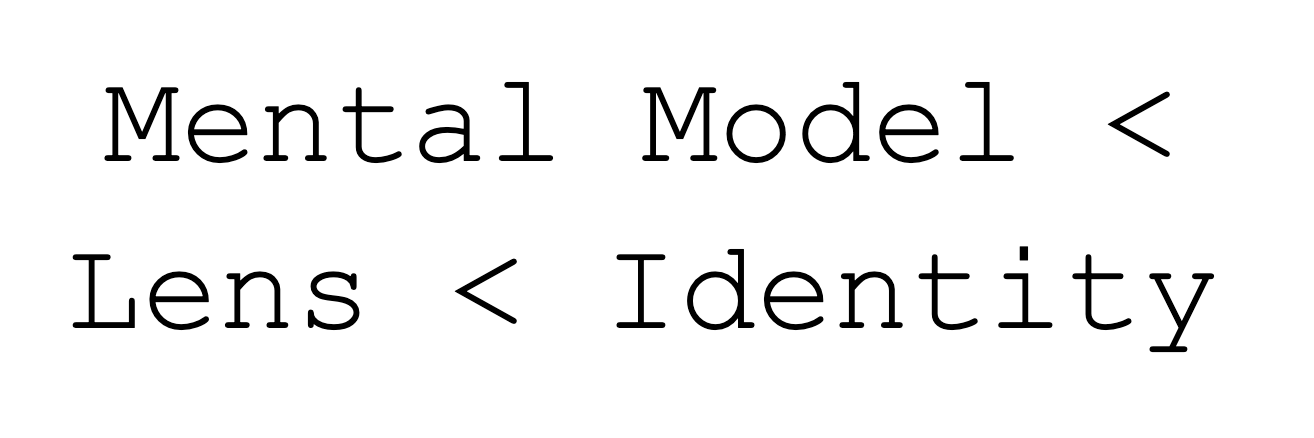
As it relates to these similar ideas, I view a Mental Model as a cognitive tool that you can whip out to analyze a situation, whereas Identity is a core part of a person that is often challenging to separate. A lens is bigger than a mental model but smaller than identity. A lens might be a school of thought that has influenced your worldview, whereas identity is core to your being.
Example: Peter Zeihan bases his geopolitical theories on his background in geography. In The Accidental Superpower, he makes the case that geography largely determines the fate of nations. In this example, he argues that American success in large part is due to having fertile soil and the best navigable waterways in the world. He contrasts this with China:
Within China itself, the North China Plain is where the majority of the Chinese live. That's where the Han ethnicity originated, the center of their power, but it's not like the American Midwest. The soils are thinner, they're not as fertile, and they don't have a river transport system. Moving things by water is about 1/12 the cost of moving them by land, and so American farmers can tap the greater Mississippi system to shuttle stuff around very cheaply. The Yellow River not only is not navigable, it's both drought and flood prone. You have very few average years. If you have a flood year, it tends to overthrow its banks. The last time it did that, it killed about a 100,000 people. If you have a drought, that's not useful for much at all. If your homeland is both drought and flood prone, it's difficult to have continuity there. Most of Chinese governance until 20 years ago was focused on managing the water system, because if you couldn't manage the water system, you couldn't irrigate, you couldn't farm, you couldn't have a population... The United States' geography is fantastic. The Midwest is the largest chunk of high-quality temperate zone agricultural land in the world and it's directly overlaying the world's largest interconnected, naturally navigable waterway system. The greater Mississippi by itself has about the same number of miles of navigable internal waterways as the rest of the world's river systems combined... All told, we're just shy of 20,000 miles here. The rest of the world combined has about 11.
Zeihan discusses the role of energy, demographics, and de-globalization (the book was published in 2014, well before this was a commonly accepted view — lending credence to the idea that unique lenses yield unique insights), but frequently ties his arguments back to his fundamental lens of geography.
Famously, from his physics background, Elon Musk likes to think about things from first principles (like actually though… before "first principles" became a platitude). When discussing the economics of The Boring Company, Elon doesn't simply accept the constraints of what have come before, he re-examines them (hence, first principles) and against nearly everyone's gut reaction, concludes that it is viable to dig miles of tunnels underground. He goes from discussing the minimum diameter of the tunnels to the idle time of the drills, to the thermal and power limits of the drills and concludes that we could have an order of magnitude cheaper cost, deriving that cost from individual contributing improvements.
Elon: So I don't know if you notice in the video but there's no real limit to how many levels of tunnel you can have. You can go much further deep than you can go up. The deepest mines are much deeper than the tallest buildings are tall, so you can alleviate any arbitrary level of urban congestion with a 3D home network...
Chris: But people, seen traditionally it's incredibly expensive to dig, and that would block this idea.
Elon: Yeah. Well, they're right... I think we need to have at least a tenfold improvement in the cost per mile of tunneling... So the first thing to do is to cut the total tunnel diameter by a factor of two or more... if you shrink that diameter to what we were attempting which is 12 feet... you drop the diameter by a factor of two and the cross-sectional area by a factor of four and the tunneling costs scale with the cross-sectional area. So that's roughly a half order of magnitude improvement right there. Then tunneling machines currently tunnel for half the time then they stop, and then the rest of the time is putting in reinforcements for the tunnel wall. So if you design the machine instead to do continuous tunneling and reinforcing, that will give you a factor of two improvement. Combine that and it's a factor of eight... I think you can get at least a factor of two, maybe a factor of four or five improvement on top of that. So I think there's a fairly straightforward series of steps to get somewhere in excess of an order of magnitude improvement in the cost per mile.
Chris: You want to beat Gary.
Elon: We want to beat Gary. He's not a patient little fellow. That will be victory. Victory is beating the snail.
Interestingly, First Principles Thinking is commonly described as a mental model. In Elon's case, I'd argue that his entire background in physics and engineering is the lens. The constituent individual tools plus the overall influence on his thinking is what differentiates a mental model from a lens.
In writing this, I gave some thought to externalizing some of the lenses I've collected from my own experience:
Early hacker culture ➡️ Paul Graham and the birth of modern startup culture
The early internet I grew up with in the 80s and 90s was weird and heterogeneous. People were technical and resourceful, as everyone was still figuring out what to do with this nascent communication system. Websites were mostly text and then as graphics became possible, they were still hand-coded and unique, each one being an artisanal reflection of the owner's tastes and interests. You had to go hunt around for stuff, not like today where you're fed things by The Algorithm. The earliest hacker culture predated me (60s on) but I got to experience the period before the Information Superhighway went mainstream. Some of the cultural values that were influential were:
- Freedom: Stewart Brand was famously slightly misquoted as saying, "Information wants to be free", while Timothy May argued for sovereignty and economic freedom in The Crypto Anarchist Manifesto. Eric Hughes deemed privacy "necessary for an open society in the electronic age" in A Cypherpunk's Manifesto.
- Playfulness and exploration of knowledge: Hacking was often seen as a form of play: tinkering, exploring, and pushing the limits of what technology could do for the fun and challenge of it. There was an anti-establishment attitude, shown in humor like a hacker group Cult of the Dead Cow creating a hacking tool called Back Orifice, a play on Microsoft Back Office. There existed an interesting meritocracy: people were often anonymous handles and skills and cleverness earned respect, not titles or degrees. Anyone could publish code (this continues from then to today with Open Source movement).
- Anti-Authoritarianism: Suspicion of bureaucracy, big corporations, and government was common. Hackers often worked around rules that they thought were dumb or unjust and publications like 2600 and Phrack celebrated this mentality. As a nerd and mildly disaffected youth, I recall being moved by The Hacker Manifesto.
As the internet became mainstream, there became a business case for building on top of it. Paul Graham's seminal essays starting in the early 2000s catalyzed a wave of thinking that became modern startup culture.
PG wrote about being a hacker — in this case more of a builder, tinkerer, or founder than the anti-authoritarian hackers of the previous era. Where hackers were previously nerds beholden to MBAs in a corporate setting, they became the star of the show. YC ushered in an era of founder-led companies with an ethos around having a builder mindset and product obsession ("make something people want"), growth ("startups = growth"), and smart risk taking (ambition + non-consensus thinking).
In the same timeframe, other thinkers like Peter Thiel (secrets, i.e. non-consensus + right), Marc Andreessen (Product/Market fit, The Only Thing That Matters, 2007) and many others contributed to the vast corpus of lore that comprises the current startup ecosystem.
Despite the modern internet becoming more standardized and corporate, the past era's ethos lives on and you can draw a continuous line between the cultural influences:
- Early hackers ➡️ Silicon Valley startup builders
- Free information + collaboration ➡️ Open Source
- Crypto anarchism ➡️ Bitcoin / Web3. Modern crypto culture espouses borderless economies, self-sovereignty, and privacy.
The Vietnam War and subsequent refugee experience

I became interested in this period of history during early adulthood, motivated by a desire to better understand the experiences of my older family members.
Quick history context: The Vietnam War had a similar setup to the Korean War. Post-WWII, the country was divided into two. The Communist North, supported by China and the USSR fought the non-Communist South which was supported by the US, Australia, South Korea, and others. Unlike Korea, which resulted in a stalemate and two separate countries, North Vietnam conquered South Vietnam in 1975, setting off a refugee crisis. Over 1 million Vietnamese fled communism and were resettled in other countries.
High school history is largely framed through the lens of the Cold War, the Counterculture movement, the Civil Rights movement, and anti-war activism. It almost completely ignores the agency and experience of the South Vietnamese (and the resultant 1.6 million refugees is a small footnote). I remember a single textbook chapter that mashed all these topics together without mentioning a single South Vietnamese leader, major battle, or political decision.
This lack of representation is not surprising — history is written by the winners, and in this case, the dominant narratives were shaped by Americans ready to put this chapter behind them and the victorious North Vietnamese. However, when I dug deeper, I realized the truth was not so simple. Reading perspectives from South Vietnamese leaders, refugees, and historians gave me a more nuanced understanding of a complex historical event. This led me to insights on the following:
The role of the media in shaping public opinion.
Vietnam was the first war broadcast into living rooms across America, and graphic footage of the brutality — body counts, burning villages, terrified civilians — profoundly influenced public sentiment. Media coverage often amplified anti-war sentiment by showing shocking images and stories without context. For example, the iconic Napalm Girl photo, often interpreted as an American war crime, actually captured a tragic friendly-fire accident when South Vietnamese pilots mistakenly dropped bombs on civilians while targeting communist forces. Similarly, Eddie Adams's Pulitzer Prize-winning "Saigon Execution" photo of General Nguyen Ngoc Loan became a symbol of alleged American-backed brutality. However, Adams later expressed deep regret, explaining that the photo stripped away context. Loan was executing a Viet Cong terrorist who had just killed a South Vietnamese official's entire family. Adams said,
Two people died in that photograph: the recipient of the bullet and General Nguyen Ngoc Loan. The general killed the Viet Cong; I killed the general with my camera. Still photographs are the most powerful weapons in the world. People believe them; but photographs do lie, even without manipulation. They are only half-truths. ... What the photograph didn't say was, "What would you do if you were the general at that time and place on that hot day, and you caught the so-called bad guy after he blew away one, two or three American people?" ... This picture really messed up his life. He never blamed me. He told me if I hadn't taken the picture, someone else would have, but I've felt bad for him and his family for a long time. ... I sent flowers when I heard that he had died and wrote, "I'm sorry. There are tears in my eyes."
My study of this period of history helped me clearly see what was happening with the decline of traditional media in the last decade. I saw the cracks in public trust toward American media forming as early as 2015. As a thought experiment, I made a habit of reading both far-left and far-right outlets to compare how they covered the same events. Watching Breitbart and The Huffington Post frame identical stories in completely opposing ways made it clear how fractured the information landscape had become. Even legacy institutions like The New York Times began to reveal biases and omissions that eroded their credibility. This shift helped explain the rise of long-form podcasts and direct-to-audience platforms: spaces where nuance and back-and-forth were still possible. I was unsurprised that when Donald Trump turned to podcasts, X, and Truth Social to bypass traditional gatekeepers, it would resonate with voters.
The enduring power of the American Dream.
Why is America the number one place in the world people want to immigrate to? People come to this country to flourish. Despite its flaws, America offers a system where individuals have the chance to thrive — a contrast that becomes even sharper when viewed through the eyes of those who fled repression in places like Vietnam. The importance of this country's founding principles including free speech, freedom of economic activity, and safeguards around tyranny cannot be understated. The United States, often called a "young country", is actually one of the oldest continuous governments in existence. If something has worked for a long time, there's better evidence that the idea is correct.
Design Thinking, circa 2010
Design Thinking is often caricatured today as a bunch of suits clustering around a whiteboard plastered with Post-its, "brainstorming" ideas. But I'd argue that this stereotype exists precisely because Design Thinking was so successful. It brought user-centric design into the mainstream. Now, concepts like user empathy, iteration, and rapid prototyping are widely accepted, and structured processes like Design Sprints have emerged as normal practice. But it wasn't always this way. Before this movement gained traction, there was far less awareness around designing for people.
My first experience with Design Thinking was in 2010 at the Stanford d.school, founded by legendary designer and IDEO co-founder David Kelley. I recall being blown away by concepts I had never seen anywhere else:
- The importance of iteration. As my d.school colleague Perry Klebahn often says, "No business plan survives contact with customers." Universally understood now, this thinking evolved over many years as pushback to overly rigid planning processes, and this was my first exposure to a systematized version of Dwight D. Eisenhower's quote: "Plans are useless, but planning is indispensable" (1950s). Other related historical lenses contributed to how I pieced together how this came together like the Mythical Man Month (1975), the Agile Manifesto (2001), the Lean Startup movement (Steve Blank 2005, Eric Ries 2011).
- Imperatives like "Show Don't Tell" and "Bias to Action" implored students to put things into the world (today's version is "You can just do things").
- Radical collaboration. For the first time, I worked alongside people from vastly different backgrounds — engineering, humanities, medicine, and more. The d.school intentionally fostered this cross-pollination to spark broader creativity.
- Creative mindset. I learned the power of ideating without judgment and separating idea generation from evaluation. Frequently I meet people who are quick to reject ideas because they are stuck in an evaluative mode — they aren't able to suspend disbelief for a moment and explore the realm of possibility. From Jonny Ive: "Ideas by definition, are always fragile." It's important to be supportive, generative, and inquisitive of new ideas.
Human Biology

As an undergrad at Stanford, I majored in Human Biology, an interdisciplinary study that includes anthropology, sociology, psychology, biology, chemistry, genetics, evolution, physiology, anatomy, epidemiology, etc. It gave me the belief that human systems cannot be fully understood by looking at them through a single discipline. (meta-point here: Human Biology itself is a practice of using different lenses)
One enlightening example: why can some people drink milk as adults without issue, while others cannot? Most mammals, including humans, lose the ability to digest lactose after weaning because their bodies stop producing the enzyme lactase. However, some populations, notably Northern Europeans, exhibit "lactase persistence," meaning they continue to produce lactase into adulthood. One hypothesis posits that in northern environments, where sunlight is weaker, people have a harder time making vitamin D in their skin. Vitamin D is important because it helps the body absorb calcium, which is critical for healthy bones. Milk is a good source of both calcium and vitamin D. In populations that could drink milk into adulthood, individuals could better absorb calcium even in low-sunlight areas. Natural selection favored individuals who were lactase persistent because they could drink milk, absorb calcium better, stay healthier, and have more surviving children. So lactose tolerance (and thus, a culture of drinking milk) became a biological and cultural adaptation.
Another example involves the practice of geophagy (eating dirt) among pregnant women in some cultures such as Africa and the southern U.S. When Western colonizers and missionaries first encountered geophagy in Africa, they reacted with disgust, interpreting it as a sign of disease, primitivism, or moral failing. It wasn't until later that anthropologists studied the practice more seriously, uncovering the possibility that certain clays could bind to toxins or pathogens and might supplement diets with minerals like calcium, iron, or zinc. It's quite possible that this practice is a cultural adaptation to environmental pressure. The science is still not 100% conclusive on this, but it underscores the idea that things must be examined holistically and deeply and not dismissed out of hand.
Seeing these phenomena be explored across multiple disciplines has led me to think deeper on issues where:
- Things have been done a certain way for hundreds of years. For instance old wives' tales, is there a deeper reason behind this practice? Before dismissing it as outdated, I now look for the underlying logic that may have justified it originally or what might have driven its mimetic survival. It brings up the idea of Chesterton's Fence (The Thing, 1929):
There exists in such a case a certain institution or law; let us say, for the sake of simplicity, a fence or gate erected across a road. The more modern type of reformer goes gaily up to it and says, 'I don't see the use of this; let us clear it away.' To which the more intelligent type of reformer will do well to answer: 'If you don't see the use of it, I certainly won't let you clear it away. Go away and think. Then, when you can come back and tell me that you do see the use of it, I may allow you to destroy it.'
- Things have been independently developed across cultures (for example, plant medicine). Why did multiple, unconnected societies arrive at the same conclusion? If diverse groups of people, working with different resources and in different environments, found similar solutions, does that increase the probability there may be some truth in it?
- Different cultures do things in different ways, all seemingly with success. Take for example the topic of kids' sleep. There are vigorous debates about the benefits or evils of co-sleeping, sleeping outdoors, sleep training etc. In the US, co-sleeping is less recommended by the medical establishment whereas in Asia it is the norm. In Europe, it is common to leave a bundled up, sleeping baby outdoors while parents visit a cafe but in the US it would be considered neglectful. Different practices are adaptations to different environments, values, and constraints, and recognizing that flexibility indicates to me there are likely multiple valid ways of doing any given thing.
Science is the exploration and testing of unknowns. It requires being data driven, but I posit that it also requires having breadth. The Human Biology lens has led me to ask "why?" far more often and to dig deeper (with healthy skepticism) into both data and anecdote.
This perspective has taught me that just because something can't yet be explained with the tools at hand doesn't mean it's false. At the same time, it has driven me to apply more first-principles thinking to biological phenomena.
Take masks during COVID, for example: Do they work? Physics asks whether particles pass through or around the mask. Biology questions whether the virus spreads through droplets or aerosols. Culture asks why, in Japan, people wear masks when they're sick. Sociology considers whether Americans have the temperament to follow mandates. Developmental science wonders what the impact is on children. The argument most people gave me at the time was, "The CDC said…" and it stopped there. This experience deepened my skepticism toward both health influencers (often lacking fundamental depth and breadth in underlying fields) and healthcare professionals who approached complex issues through a single lens.
Practical matters, and why is this important?
Seeing the world through our own defaults limits our objectivity, creativity, and empathy, while knowing your own lenses helps you understand why you believe what you believe.
What are things you can do to improve your fluency with lenses?
- Have varied life experiences - this could be anything from living in different places to learning a new field of study to participating in various hobbies. Every experience can bring a new lens.
- Become acquainted with people from all different backgrounds — because every person brings new lenses.
- Notice the glasses others are wearing: this helps you empathize and understand others' motivations.
- When you hold a strong opinion, ask yourself: what lenses or part of my identity might be causing me to hold such a strong opinion?
- Write down your lenses. I found this exercise powerful and thought provoking.
Consider the glasses you are wearing and where they came from. When you can notice this, you gain clarity in thinking. The real edge isn't just having the right lens (there isn't one!), it's knowing you're wearing glasses at all. Most people operate on autopilot, stuck inside a single frame without realizing it, but the sharpest thinkers zoom out and question the defaults. They try on other lenses, even the uncomfortable ones.